
Key Takeaways
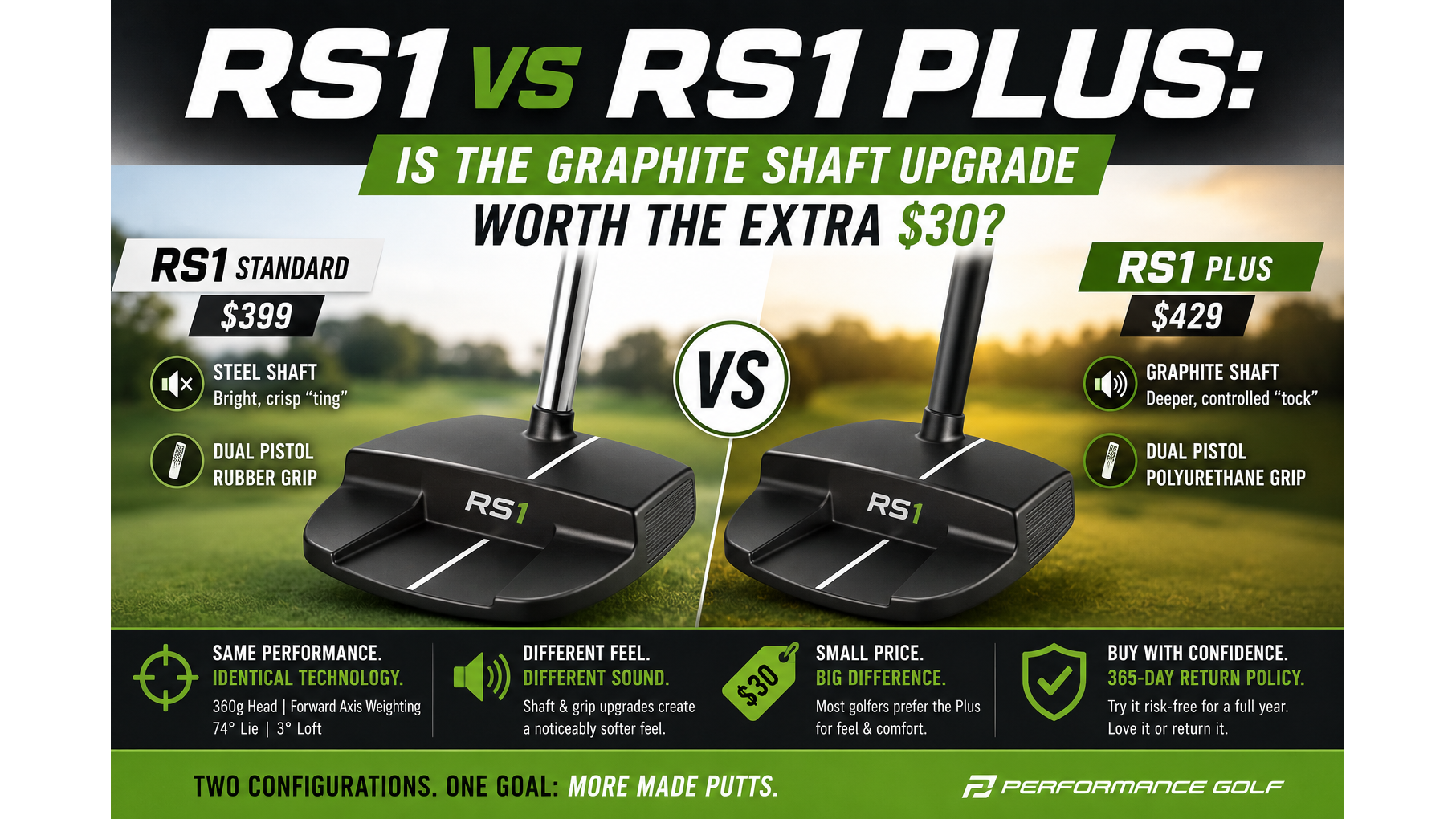
- The Performance Golf RS1 and RS1 Plus deliver identical putting performance – the same 360g head, 74° lie angle, 3.5° loft, and Forward Axis Weighting technology.
- The only meaningful differences are the shaft material (steel vs. graphite) and grip material (rubber vs. polyurethane), which together change the sound and feel at impact – not the mechanics.
- Steel shaft produces a bright, high-pitched “ting”; graphite produces a deeper, dampened “tock” – and science confirms that sound directly shapes how feel is perceived.
- Golfers who find their putter feeling right tend to putt with greater confidence from short range, making feel satisfaction a performance factor worth taking seriously.
- Both configurations are backed by a 365-day return policy, making either choice essentially risk-free – details on how to evaluate both are covered further below.
The $30 price gap between the RS1 Standard and RS1 Plus looks like a minor footnote. The actual difference in on-course experience is bigger than that number suggests. Understanding exactly what changes – and what stays the same – makes the decision straightforward.
$30 Apart, Yet the Sound Gap Is Bigger Than the Price
At $399 versus $429, these two putters sit close together on paper. The shaft and grip materials create two genuinely different sensory experiences, even though the underlying putting technology is mechanically identical. That’s the central tension worth understanding before choosing between them.
Fairway Tips and News has broken down the full RS1 vs. RS1 Plus comparison at golfersparidise.com/rs1-vs-rs1-plus/, covering specs, feel profiles, and buyer guidance in one place. The short version: same putter, different sensory experience – and that difference matters more than its price tag suggests.
The Specs That Never Change
Shared Head, Geometry, and Face-Squaring Tech
Both configurations use the same 360-gram head, a 74-degree lie angle, and 3.5-degree loft. Both use Forward Axis Weighting, which positions 75% of the putter’s weight in front of the shaft axis – using gravity to keep the face square to the target line throughout the stroke. The upright lie angle also places the golfer’s eyes more directly over the ball, tightening the stroke arc for a more repeatable motion.
None of that changes between the Standard and the Plus. The face-squaring mechanism, the geometry, the head weight – all identical. What changes is everything above the head.
Two Materials, One Changed Feel Experience
Steel Shaft and Rubber Grip: Bright, High-Pitched “Ting”
The RS1 Standard uses a stepless steel shaft paired with a Dual Pistol Rubber grip. Steel is rigid and transmits vibration efficiently – which generates that bright, high-pitched sound at impact. Multiple independent reviewers have described it as a “ting” or “ping,” consistent with what happens acoustically when a steel face meets a steel shaft. The rubber grip provides solid comfort and durability, with good traction across all grip styles.
This setup is familiar to golfers who have played traditional milled blade putters. The feedback is crisp and immediate. Some players prefer exactly that – a sharp auditory cue that confirms center contact.
Graphite Shaft and Polyurethane Grip: Deeper, Dampened, Muted Sound
The RS1 Plus uses a 15mm low-torque graphite shaft and a Dual Pistol Polyurethane grip. Graphite absorbs high-frequency vibration before it travels up to the hands, shifting the impact sound to something deeper and more controlled – closer to a “tock” than a “ting.” The polyurethane grip adds a slightly tackier, softer feel under the hands compared to standard rubber, with marginally better vibration absorption as a secondary benefit.
The result is a putter that still has a firm, solid character – both configurations use a steel face, so neither replicates the soft, pillowy feel of a urethane insert putter – but with the harder edges meaningfully softened. Think of the Plus as a premium milled putter paired with a quality dampening shaft, rather than an entry-level or mid-tier feel profile.
Why Sound Shapes Feel
The brain does not separate sound and touch at impact – it fuses them into a single perception. Research into multisensory feedback confirms that auditory cues directly influence how a golfer interprets feel. A louder, higher-pitched impact sound is perceived as a harder, less controlled hit, even when ball speed is identical. A muted, lower-pitched sound reads as softer and more controlled.
This is not a minor psychological quirk. Scientific consensus supports that feel satisfaction – independent of mechanical performance – correlates with greater putting confidence from short range. A putter that sounds and feels wrong creates subtle doubt before, during, and after a stroke. That doubt compounds across a round. Choosing the configuration whose sensory profile aligns with individual preference is a genuine performance variable, not a luxury consideration.
Standard or Plus? Match Your Buyer Profile
Choose Standard: Firm Feedback, Full Performance
The RS1 Standard is the right call in a few specific situations:
- Indifference to acoustic feedback. Some golfers focus entirely on results and do not register putter sound as a factor. The $30 saved represents zero performance tradeoff for this buyer.
- Preference for crisp, firm feedback. A sharp “ting” at impact can serve as a useful stroke cue – confirming center contact and helping certain players feel more connected to their motion.
- Budget priority. The Standard delivers the full face-squaring performance of the RS1 line at the lower price. If solving a face rotation problem is the primary goal and feel refinement is secondary, the Standard is a completely legitimate choice.
Choose Plus: Golfers Sensitive to Sound or Seeking a Softer Experience
The Plus is the better fit for a larger share of buyers:
- Coming from a soft-insert putter. Golfers calibrated to urethane or polymer face inserts will find the Standard’s steel-on-steel acoustic profile jarring by comparison. The Plus narrows that gap considerably.
- Any sensitivity to sharp, high-pitched impact sound. The Standard is genuinely loud and bright relative to most modern putters on the market. On a quiet course, that difference is noticeable.
- Senior golfers or anyone with hand sensitivity. The graphite shaft reduces vibration transmission meaningfully over 18 holes, particularly on mishits.
- Preference for a premium dampened feel. Many putters in the $300+ category from established manufacturers use dampening shaft technology as a standard feature. The Plus brings the RS1 line in line with that expectation.
- Uncertainty about which to choose. The $30 differential is small relative to the overall purchase price, and feel dissatisfaction is one of the most common reasons a new putter gets abandoned. The Plus reduces that risk.
Feel Satisfaction Drives Real Results on the Green
Research consistently supports that feel satisfaction – separate from mechanical performance – correlates with measurably better putting confidence from short range. A putter that sounds and feels wrong creates subtle doubt before, during, and after a stroke, and that doubt compounds across a round. Choosing the configuration whose sensory profile aligns with individual preference is a performance variable, not a secondary concern.
Neither RS1 configuration is objectively better. The Standard’s firm feedback serves certain golfers well. The Plus’s dampened response serves others. The question is which profile supports consistent confidence over time.
Same Performance, Your Call on Feel – Both Risk-Free
Both the RS1 Standard and RS1 Plus deliver identical putting performance. The Forward Axis Weighting, the head geometry, the face-squaring mechanism – none of it changes. What changes is the sensory experience of executing a putt, and that experience has a real influence on results.
For most golfers evaluating this choice, the Plus is the lower-risk option: the feel improvement is tangible, the price difference is small, and feel dissatisfaction is a common reason putters go unused. The Standard remains a strong, fully capable choice for golfers who prefer firmer feedback or have a tighter budget.
Either way, both configurations are backed by Performance Golf’s 365-day return policy. There’s room to evaluate the choice with real on-course experience before committing fully – which takes most of the pressure out of the decision.
For more equipment breakdowns, buying guides, and course-ready tips, visit Fairway Tips and News – a go-to resource for golfers looking to sharpen every part of their game.
Fairway Tips and News
8767 3rd Avenue
Pleasant Prairie
WI
53158
United States


