CHENGDU, SICHUAN, CHINA, November 3, 2026 /EINPresswire.com/ — When evaluating commercial hydrogen production equipment, technical directors often examine a global advanced PEM Supplier to benchmark dynamic response against pressurized alkaline architectures. A credible comparison requires separating core cell physics from complete production systems. Proton exchange membrane and alkaline systems rely on distinct ion-transport mechanisms and balance-of-plant arrangements. Sourcing managers must normalize what each equipment manufacturer actually delivers before judging headline performance metrics. Houpu’s documented engineering data in this analysis remains specific to pressurized alkaline electrolysis, providing a concrete baseline for full-envelope technical evaluation.
Start with the Full System Boundary, Not the Stack Label
A rigorous procurement evaluation begins by defining the conversion mechanism. According to Department of Energy technical guidelines, proton exchange membrane electrolysis utilizes a solid proton-conducting membrane with precious-metal catalysts, whereas alkaline electrolysis relies on liquid potassium hydroxide electrolyte and hydroxide-ion transport across a porous diaphragm. These physical principles dictate auxiliary fluid circuits, gas drying stages and operational parameters across the complete plant footprint.
Procurement teams should treat the electrolyzer stack as one component within a broader balance of plant. A functional hydrogen facility incorporates power conversion, water deionization, gas-liquid separation, catalytic purification, closed-loop cooling, multi-stage compression, automated plant controls and distribution manifolds. Comparing an established PEM supplier with alternative designs solely by stack dimensions obscures the physical space, utility demands and integration labor required by peripheral subsystems.
Engineering proposals frequently quote identical hourly hydrogen outputs while assuming entirely different battery limits. One supplier might deliver an unassisted cell stack requiring external gas cooling, while another supplies skid-mounted separation, deoxypurification and centralized automation. Conducting an objective electrolyzer supplier comparison requires establishing clear scope parity: capacity, delivery pressure, output purity, electrical consumption, turndown ratios, restart profiles and commissioning scopes must be normalized across equivalent operational boundaries.
Where PEM and Alkaline Routes Create Different Project Decisions
Power profile and operating flexibility
Variable renewable power from solar photovoltaics or wind turbines introduces rapid electrical fluctuations that affect technology selection. In assessing PEM vs alkaline electrolysis, the World Bank ESMAP hydrogen analysis emphasizes that no single electrolysis technology provides an optimal solution for every electrical profile. While PEM stacks deliver rapid ramp rates, alkaline systems equipped with modern power electronics handle significant modulation while offering durable multi-megawatt operational economics. Sourcing teams must verify whether stated ramp rates apply to the bare stack or the complete production train including gas drying units.
Site footprint and modularity
Stack compactness does not guarantee minimal overall site footprint. PEM cell stacks occupy modest floor areas, yet their dedicated power rectifiers, water polishing loops and chilling units require substantial real estate. Conversely, industrial alkaline installations integrate robust vertical gas-liquid separators and circulation skids. Sourcing teams evaluating a PEM supplier against skid-based alkaline designs must evaluate total plot requirements, maintenance corridors and crane access rather than evaluating standalone stack skid dimensions.
Water, electrolyte and materials
Water preparation requirements differ substantially between technologies. PEM systems demand high-resistivity deionized water to prevent membrane fouling, utilizing platinum-group electrocatalysts and titanium cell frames. Alkaline electrolyzers circulate potassium hydroxide electrolyte through nickel-coated steel electrodes and specialized diaphragm separators. Sourcing engineers must contrast the cost of ongoing electrolyte management against the capital expense and replacement frequency of precious-metal catalyst-coated membranes.
Product pressure and downstream processing
Electrolyzer delivery pressure shapes downstream gas compression and storage logistics. Evaluating stack discharge pressure in isolation can lead to sizing errors in gas purification and booster systems. Generating raw hydrogen at intermediate pressure reduces suction stages for vehicle refueling compressors, but requires rigorous gas-liquid level management and oxygen-side differential pressure balancing across variable operating envelopes.
Scale, maintainability and operating history
Plant capacity and lifecycle servicing define commercial feasibility. Pressurized alkaline technology provides decades of documented operational history in heavy industrial chemical manufacturing. Maintainable module sizing, standardized pump seals and proven overhaul procedures provide plant operators with predictable maintenance costs. Technical teams must compare field-proven component lifespans, factory refurbishment intervals and localized spare-parts availability before committing capital.
Houpu’s Alkaline System Architecture
Houpu structures its industrial alkaline electrolysis system design around five documented, standardized functional units:
Electrolysis unit: Houses the bipolar cell stack where regulated direct-current electricity splits treated water into hydrogen and oxygen streams.
Separation unit: Performs primary gas-liquid separation, isolating raw hydrogen and oxygen from circulating potassium hydroxide electrolyte.
Purification unit: Implements catalytic deoxidation and adsorption drying to elevate crude gas quality to high-purity industrial standards.
Power supply unit: Combines transformers and thyristor or IGBT rectifiers to deliver stable, high-amperage direct current to the electrolyzer.
Alkali circulation unit: Manages electrolyte mixing, pump circulation, particulate filtration and process temperature regulation.
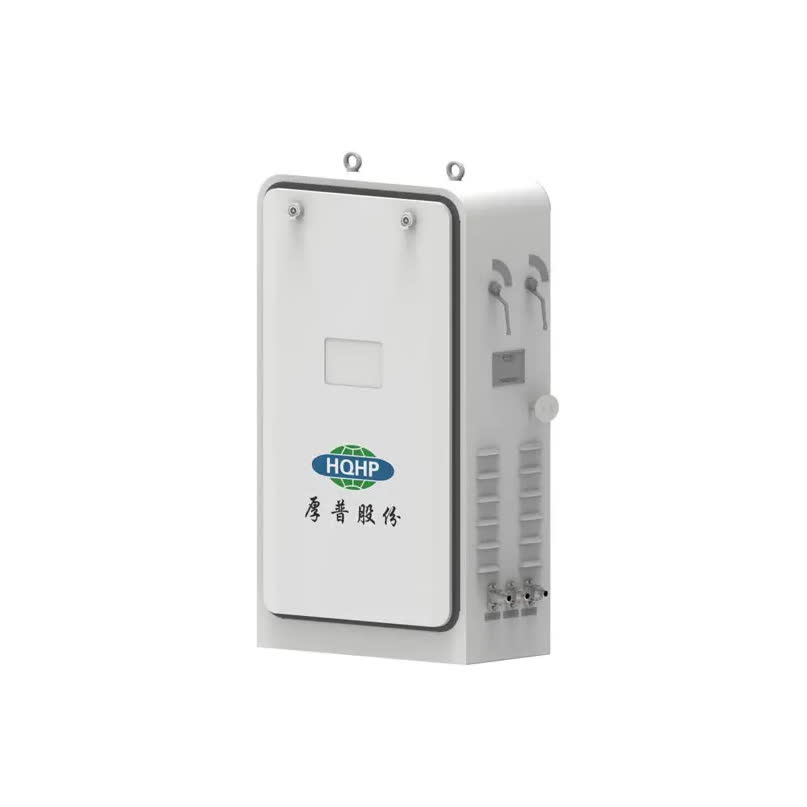
To address diverse installation environments, the product portfolio provides split systems engineered for large-scale centralized production facilities, alongside integrated, skid-mounted systems configured for fast on-site commissioning, transportable fueling infrastructure and testing installations.
Translate Houpu’s Operating Envelope into Buyer Questions
Houpu’s FT-series encompasses hydrogen generation capacities ranging from 100 to 1,500 Nm³/h per system. The published engineering baseline specifies an adjustable discharge pressure of 1.6 MPa, a process temperature of 85±5°C, crude hydrogen purity of 99.8% and purified product purity reaching 99.999%. For grid-balancing duty, the system accommodates fluctuating electrical loads between 25% and 100% on a single-cell-block basis. Cold startup to full capacity requires 30 minutes, whereas hot restarts execute within 10 seconds under maintained thermal standby. Overall operational life is rated at 25 years with major overhauls every 10 years.
Technical buyers can convert this technical baseline into direct qualification questions. First, engineers must confirm whether quoted hourly output reflects net delivered hydrogen at specified temperature and pressure, or gross cell generation. Second, the inquiry must establish where purity is measured and whether automated oxygen-in-hydrogen monitoring is included.
Third, buyers should confirm whether transformer losses, cooling pumps and purification heaters are incorporated into the specific power consumption guarantee. Finally, evaluation teams should verify whether the load range applies to a single electrolyzer vessel, what thermal standby conditions enable fast hot restarts, and which overhaul tasks require specialized lifting equipment.
Compare Supplier Responsibility Across the Project Chain
A dependable comparison must evaluate interface management between hydrogen generation and downstream utilization. In an integrated project, boundary conditions involve purification outlet pressure, compressor suction temperature, cascade storage buffering, control communications, fire-and-gas safety interlocks and operational staff qualification.
Empirical evidence of interface management is demonstrated at the Hanlan integrated generation and fueling mother station. In that facility, Houpu engineered pressurized alkaline electrolyzers, catalytic gas deoxypurifiers, cascade storage vessels and vehicle dispensers into a cohesive plant. Integrating both 35 MPa and 70 MPa dispensing alongside on-site generation proved that unified boundary management prevents field communication mismatches and installation delays.
To support multi-megawatt industrial projects, Houpu maintains extensive precision manufacturing facilities and a technical workforce exceeding 100 engineering specialists. The enterprise holds 494 granted patents and 124 registered software copyrights, alongside 60 explosion-proof approvals and 138 European CE certifications. Beyond equipment manufacturing, Houpu has contributed to drafting 21 national standards and 7 regional technical codes, ensuring delivered hardware conforms to strict pressure-vessel and electrical safety mandates.
A Better Decision Rule Than “PEM or Alkaline?”
Rather than selecting a technology based on abstract preference, technical buyers should anchor their decision in empirical project constraints: available power quality, delivery pressure requirements, footprint limits, capital allocation and maintenance philosophy. When electricity originates from stable grid connections or managed renewable arrays, pressurized alkaline systems provide reliable economics, proven component durability and high gas purity without precious-metal supply risks.
A rigorous sourcing strategy compares full equipment scopes, validated operating envelopes and single-point interface accountability. Whether consulting an international PEM supplier or an established alkaline manufacturer, selecting an equipment partner that delivers engineered, skid-integrated functional blocks ensures long-term operational availability and transparent lifecycle costs.
Making a Defensible Comparison: Base the Decision on Full System Scope
Defensible hydrogen procurement requires normalizing system boundaries, auxiliary loads and balance-of-plant interfaces before comparing supplier proposals. Houpu’s standardized alkaline architecture—integrating electrolysis, separation, purification, power conversion and alkali circulation—provides a transparent engineering reference for industrial hydrogen projects. Technical teams evaluating verified equipment integration and balance-of-plant parameters can review complete commercial systems at https://www.hqhp-en.com/.
Houpu
Houpu
Legal Disclaimer:
EIN Presswire provides this news content “as is” without warranty of any kind. We do not accept any responsibility or liability
for the accuracy, content, images, videos, licenses, completeness, legality, or reliability of the information contained in this
article. If you have any complaints or copyright issues related to this article, kindly contact the author above.

Media gallery